A citizenship exam, the naturalisation oath, or a festive Sunday mass — in Hungary, none of these happen without the national anthem. Here’s a little of its story.
The Hungarian anthem holds a unique place among the world’s national anthems: it doesn’t ask you to bow before an emperor or king, like the English God Save the King/Queen or the old Austrian Gott erhalte, and it isn’t a battle march like the Marseillaise. It is closer to a cry for help from a people who have endured much: “Szánd meg Isten a magyart…” (“Have mercy, God, on the Hungarian…”).
The lyrics were written by Kölcsey Ferenc in 1823, in an atmosphere of national pessimism and historical anxiety. The music was composed by Erkel Ferenc for a competition organised by the National Theatre in 1844.
The finished anthem was frequently criticised in the press for its ecclesiastical character. And yes, the Hungarian anthem is hard to sing. But precisely its prayerful quality resonated with Hungarians — in the anxious years before the revolution of 1848, and after it too. Hungarians have always had plenty to pray for.
Interestingly, the anthem was performed for decades without any official status. It was only in 1989 that it was legally recognised:
XXXI tv. 36. §: „A Magyar Köztársaság himnusza Kölcsey Ferenc Himnusz című költeménye Erkel Ferenc zenéjével.“
And in 2012 it was enshrined in Hungary’s Basic Law under the name “Isten, áldd meg a magyart” (“God, bless the Hungarians”).
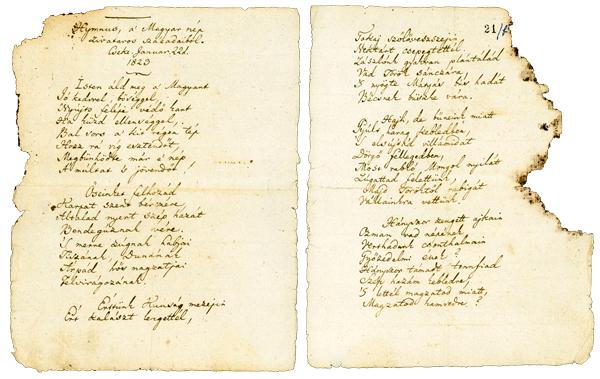
The photo shows the original manuscript of the anthem, now held at the Széchényi National Library (OSZK).
For those who want to go deeper into the anthem’s history, we recommend this documentary by the Budapest Philharmonic Society.