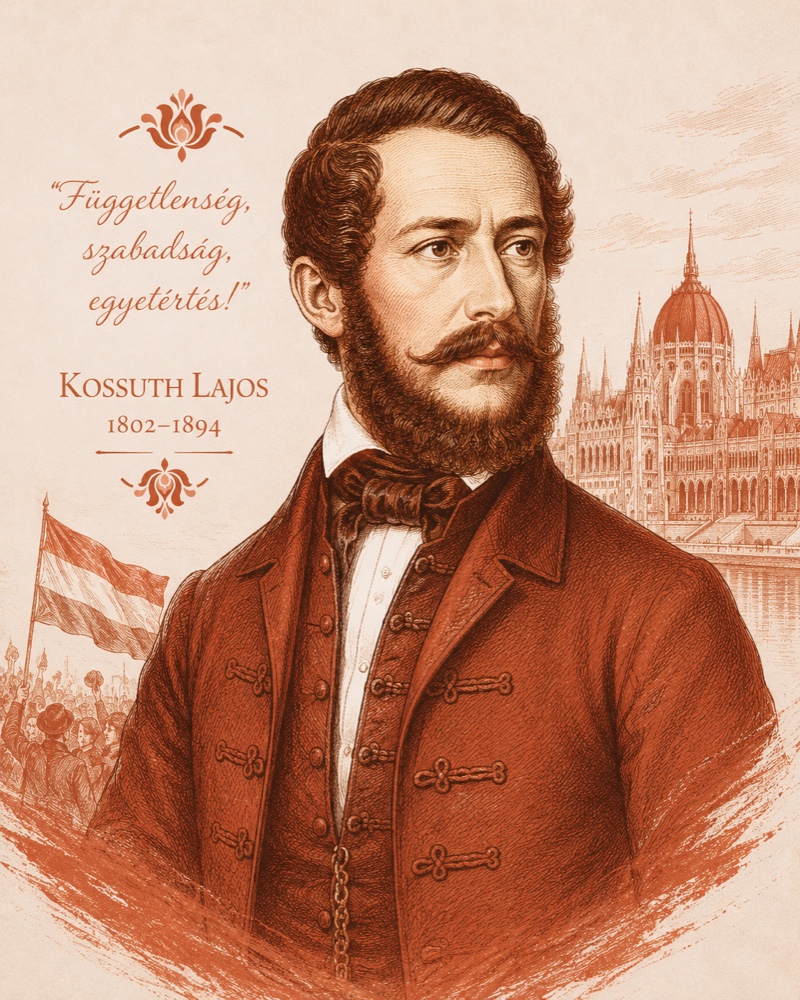
Even if you moved to Hungary recently, the name Lajos Kossuth (Kossuth Lajos) has almost certainly crossed your path more than once. The square in front of Parliament, streets in virtually every town, monuments, schools, state awards and even Kossuth Rádió are all named after him. His miniature sculpture stands even at the suspension bridge in Zemplén, which we wrote about recently.
From provincial lawyer to national leader
Lajos Kossuth was born on 19 September 1802 in the small village of Monok, into a family of minor nobility. He studied in Eperjes and Sátoraljaújhely, then enrolled at the Reformed College in Sárospatak to study law. He began his career as a lawyer, but soon realised that public life attracted him far more. Attending sessions of the Hungarian parliament, Kossuth began publishing detailed reports on what the deputies were debating — a genuine breakthrough for the time: people could now learn about politics from independent publications rather than rumour. He later reported on local assembly proceedings too, for which he was arrested and spent four years in prison. It was another major politician of the era, Ferenc Deák, who helped secure his release.
The journalist who changed public opinion
After his release, Kossuth did not abandon his convictions. In 1841 he took over the newspaper Pesti Hírlap, which quickly became the most influential political publication in the country. Through his articles and brilliant public speeches, Kossuth became one of Hungary’s most popular politicians. He advocated for reforms, freedom of the press, economic development and greater autonomy for Hungary within the Austrian Empire — contemporaries considered him one of the finest orators of his time.
Leader of the 1848 revolution
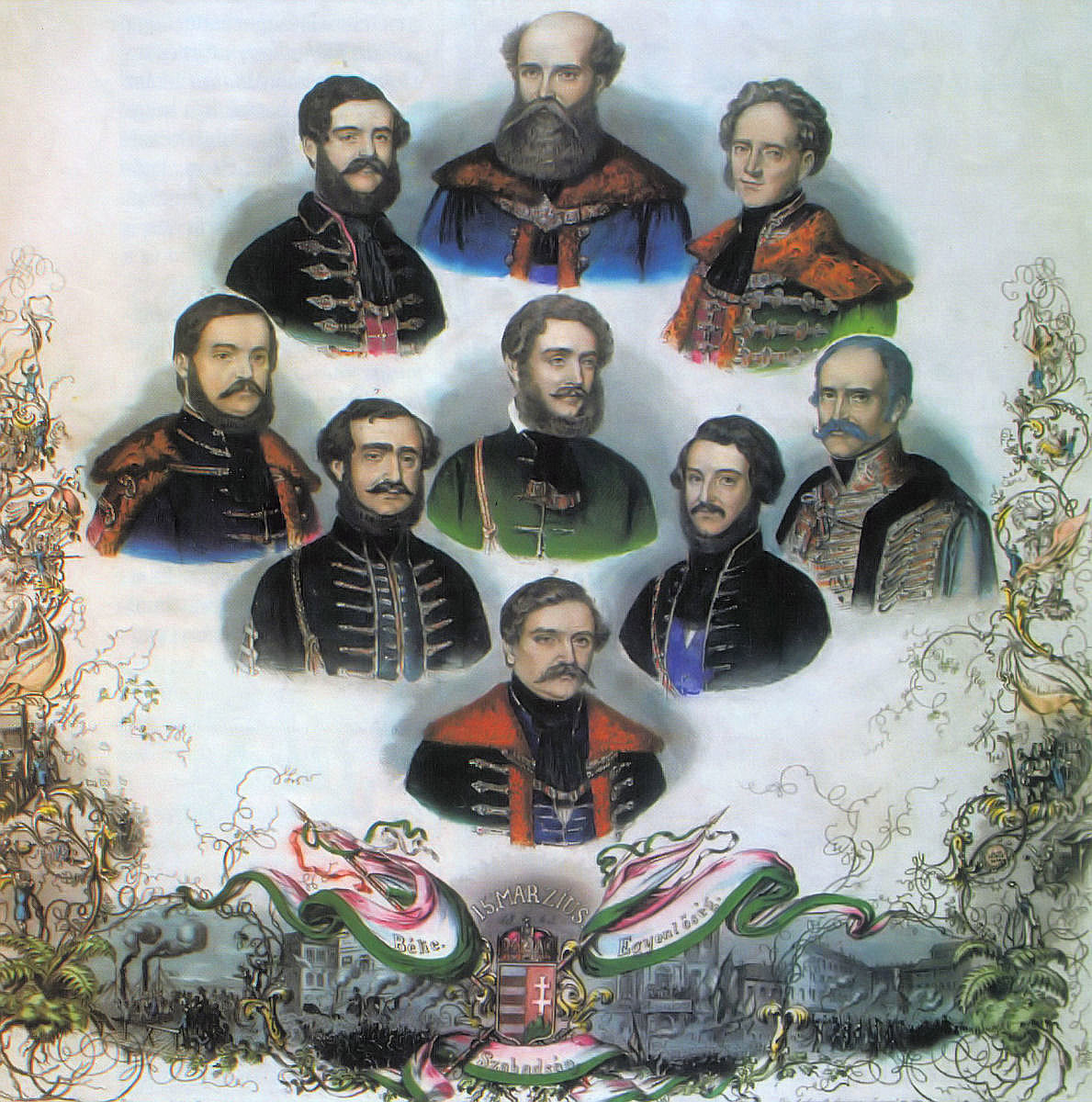
When revolution broke out in Pest on 15 March 1848, Kossuth was already the recognised leader of the reform movement. In Hungary’s first responsible government, led by Lajos Batthyány, he served as Minister of Finance. He organised the funding of the young Hungarian army and oversaw the issue of Hungary’s first paper currency, popularly known as “Kossuth banknotes”.
In the spring of 1849 the Hungarian parliament declared independence from Austria. Kossuth was elected Governor-President and effectively became head of state.
Defeat and exile
The Austrian offensive, backed by the Russian Empire, crushed the Hungarian revolution in the summer of 1849.
After the capitulation, Kossuth was forced to leave the country. For many years he lived in exile, lecturing across Europe and the United States about the Hungarian struggle for freedom and seeking international support for his homeland’s independence. He never returned. Lajos Kossuth died in Turin in 1894, having spent almost half his life far from Hungary.
Why do Hungarians venerate Kossuth so deeply?
Kossuth became a symbol of the struggle for independence and the modern Hungarian state. Several historical achievements are credited to him:
- he was the first to openly proclaim the idea of an independent Hungary;
- he laid the foundations of Hungarian political journalism;
- he actively fought for freedom of the press;
- he was one of the main leaders of the 1848–1849 revolution;
- through his efforts, the idea of Hungarian independence gained international recognition.
What to remember for the residence permit exam
According to the official OIF study guide for the cultural knowledge exam, you are not expected to know Kossuth’s biography in detail. It is enough to remember that Lajos Kossuth (1802–1894) was one of the leading figures of the Reform Era and a leader of the Hungarian Revolution and War of Independence of 1848–1849. In Hungary’s first independent government he served as Minister of Finance, and after the declaration of Hungarian independence in 1849 he was elected Governor-President and led the state. Kossuth advocated for Hungarian independence, freedom of the press and reform, and after the revolution’s defeat was forced into exile, where he spent the rest of his life. Today he is considered one of Hungary’s greatest national heroes.
The easiest way to remember him: Kossuth = Revolution of 1848 → Minister of Finance → Governor-President → symbol of Hungary’s struggle for independence.
Vocabulary reference
Key words and phrases that appear frequently in materials about Lajos Kossuth and the 1848–1849 revolution.
| Hungarian | English |
|---|---|
| a szabadságért és a függetlenségért harcol | to fight for freedom and independence |
| alkotmány | constitution |
| államfő | head of state |
| emigráció | emigration, exile |
| első felelős magyar kormány | first responsible Hungarian government |
| emlékmű | monument, memorial |
| forradalom | revolution |
| függetlenség | independence |
| függetlenségi nyilatkozat | Declaration of Independence |
| hazafi | patriot |
| honvédség | Hungarian army |
| kikiáltják a függetlenséget | to declare/proclaim independence |
| kormány | government |
| kormányzó-elnök | Governor-President |
| nemzeti emlékezet | national memory |
| nemzeti hős | national hero |
| nemzet | nation |
| országgyűlés | National Assembly, parliament |
| pénzügyminiszter | Minister of Finance |
| polgári átalakulás | civic (bourgeois) transformation |
| politikus | politician |
| reformkor | Reform Era |
| reformok | reforms |
| sajtószabadság | freedom of the press |
| szabadság | freedom |
| szabadságharc | war of independence, freedom fight |
| száműzetés | exile, banishment |
| szónok | orator |
| vezető | leader |
Practice questions and answers
Hover over ⓘ to see the translation. Click the blurred text to reveal the answer.
Ki volt Kossuth Lajos? ⓘ
Kossuth Lajos a reformkor egyik legjelentősebb politikusa és az 1848–1849-es forradalom és szabadságharc egyik vezetője volt.
Mikor élt Kossuth Lajos? ⓘ
1802 és 1894 között élt. / A 19. században élt.
Melyik korszak jelentős személyisége volt Kossuth Lajos? ⓘ
A reformkor egyik legjelentősebb személyisége volt.
Melyik történelmi esemény egyik vezetője volt Kossuth Lajos? ⓘ
Az 1848–1849-es forradalom és szabadságharc egyik vezetője volt.
Milyen tisztséget töltött be az első felelős magyar kormányban? ⓘ
Pénzügyminiszter volt.
Mi lett Kossuth Lajos 1849-ben? ⓘ
A függetlenség kikiáltása után kormányzó-elnökké választották.
Mi volt Kossuth Lajos célja? ⓘ
A magyar függetlenség kivívása és a reformok megvalósítása.
Mit támogatott Kossuth Lajos? ⓘ
A sajtószabadságot, a polgári átalakulást és Magyarország függetlenségét támogatta.
Miért fontos személy a magyar történelemben? / Miért tekintik Kossuth Lajost nemzeti hősnek? ⓘ
Mert a magyar függetlenségért, a szabadságért és a reformokért küzdött.
Mi történt 1849-ben? ⓘ
Kikiáltották Magyarország függetlenségét, és Kossuth Lajost kormányzó-elnökké választották.
Miért találkozhatunk gyakran a nevével Magyarországon? ⓘ
Mert Kossuth Lajos nemzeti hősnek számít, ezért sok utca, tér, iskola és intézmény viseli a nevét.
Hol található a Kossuth Lajos tér? ⓘ
A Magyar Országház előtt, Budapesten.
Melyik budapesti tér viseli Kossuth Lajos nevét? ⓘ
A Parlament előtt található Kossuth Lajos tér.
Kik voltak a reformkor más jelentős személyiségei? ⓘ
Széchenyi István, Batthyány Lajos, Deák Ferenc, Wesselényi Miklós és Kölcsey Ferenc.
Further reading
- Documentary about Lajos Kossuth (YouTube)
- Biography on the Reform Era Greats website (in Hungarian)