
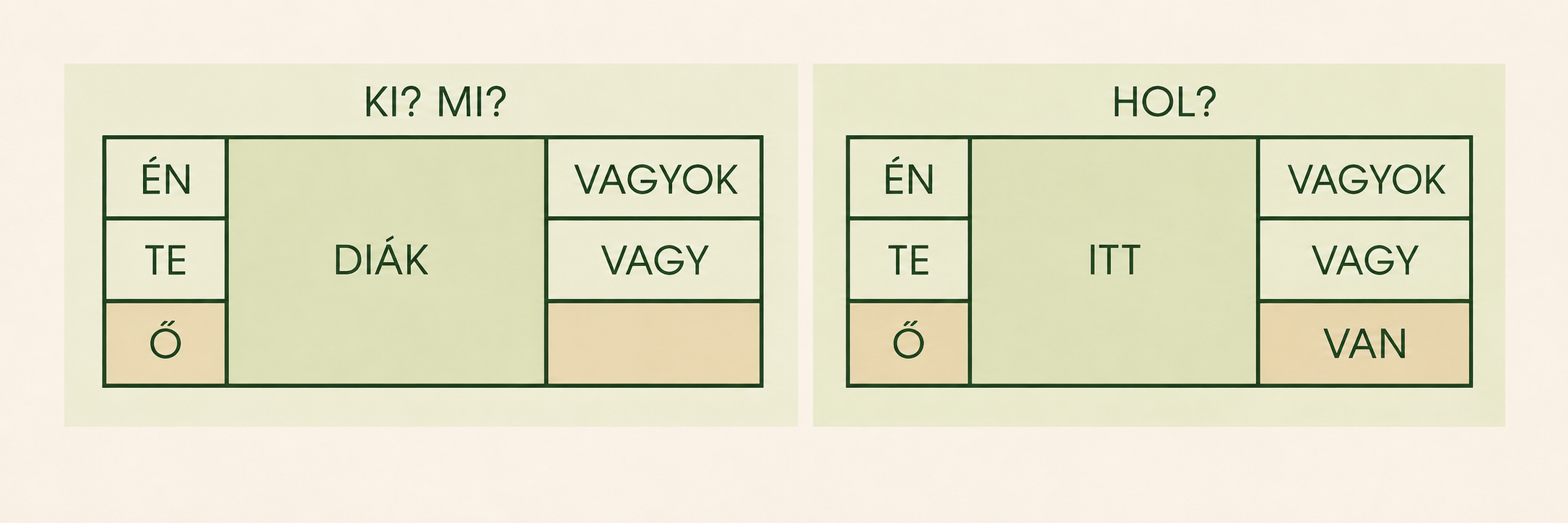
From the very beginning of learning Hungarian, we run into the same question: when do you use the verb “to be”?
The first and second persons seem straightforward — the verb is always there, and the personal pronoun is dropped in neutral sentences. Then the third person shows up…
Textbooks usually introduce this in stages, which can mislead students into thinking the verb simply doesn’t exist:
(Én) menedzser vagyok. (Te) menedzser vagy. Ő/Ön menedzser.
Got it — no verb “to be” in the third person, so we keep the pronoun to make it clear who we’re talking about. Noted.
But soon enough that famous question Hogy vagy? appears, and the answer pattern suddenly looks like this:
(Én) jól vagyok. (Te) jól vagy. (Ő/Ön) jól van.
And just like that, all the logic from the previous lesson falls apart.
How to make sense of it
First things first: the verb “to be” in the 3rd person does exist. It is van (3rd person singular) and vannak (3rd person plural).
Second, it is used in three situations:
1. Location:
Milánóban van. — He/she is in Milan. Itt vannak. — They are here. Az asztalon van. — It is on the table.
2. Mental or physical state:
Jól van. — He/she is fine. Rosszul van. — He/she is feeling unwell. Rendben vannak. — They are all right.
3. Possession (having something):
Van egy kutyám. — I have a dog. A magyar barátai vannak. — He/she has Hungarian friends. Van sok ruhátok. — You have a lot of clothes.
When talking about who someone is or what they are like, the verb is dropped:
Ő tanár. — Ők diákok. — Ön magyar? Ő gyönyörű. — Ők okosak. — Ön szomorú?
Test yourself
1. A diákok Koppenhágában _____.
The students (plural) are located in Copenhagen → vannak
2. Mária jól _____.
Mária feels well (physical state, singular) → van
3. Nem jól, hanem rosszul _____.
Physical state → van
4. Ők angolok _____?
They are English (nationality, identity) → no verb needed
5. Ők nem tanárok, hanem diákok _____.
They are students (who they are) → no verb needed
6. Magyar Péter az új miniszterelnök _____.
Péter Magyar is the prime minister (identity) → no verb needed
7. Itt _____ Katalin?
Katalin is located here? (location, singular) → van
8. A gyerekek boldogok _____ itt _____.
The children are happy (adjective predicate) — no verb in either gap
9. — _____ itt László? — Nem, parkban _____.
Both gaps ask about location → van, van
10. Itt senki nem szomorú _____.
Szomorú is an adjective describing a property → no verb needed
A formula to remember
-
If in your language you could say “is (a)” as a category or identity → no verb needed: he is a student → ő diák; she is tall → ő magas
-
If you could say “is located” or describe a state → verb needed: he is at home → ő otthon van; she is in good spirits → ő jól van