
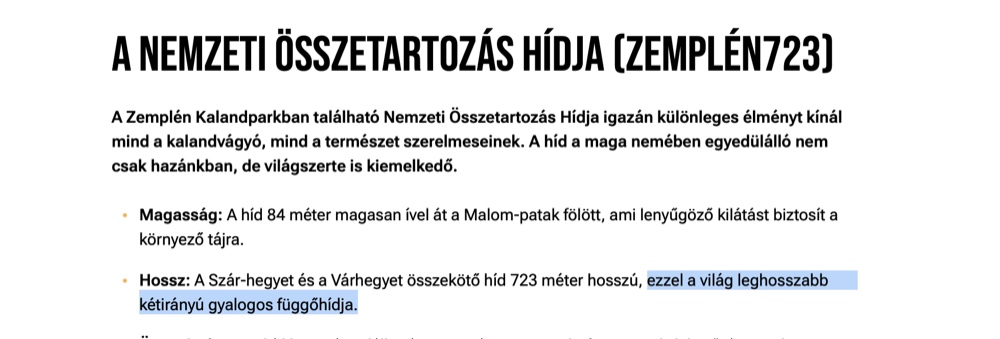
In the Маршруты section we wrote about the bridge in the Guinness World Records. But how do you express superlatives in Hungarian in general? What does “the most” actually look like?
Hungarian has three ways to compare things: when two things are equal in some quality, when one thing surpasses another, and when something is the biggest, most beautiful or most expensive of several.
When things are equal
When two things share the same quality, Hungarian uses the construction (ugyan)olyan… mint, which corresponds to English “just as… as”.
Ez az alma ugyanolyan nagy, mint az. ⓘ
Ez a ruha ugyanolyan szép, mint a másik. ⓘ
A Balaton ugyanolyan népszerű, mint régen. ⓘ
Note: a comma always comes before mint.
When one thing is bigger, more beautiful or more expensive
To form the comparative, add the suffix -bb to the adjective.
magas → magasabb — tall → taller
gyors → gyorsabb — fast → faster
olcsó → olcsóbb — cheap → cheaper
There are two ways to compare two things. The most common is with mint (“than”):
Ez a szobor magasabb, mint az. ⓘ
Budapest nagyobb, mint Debrecen. ⓘ
The second option is to use the -nál/-nél case ending:
Ez a szobor magasabb annál. ⓘ
A Duna hosszabb a Tiszánál. ⓘ
Both constructions are equally correct and common in everyday speech.
When something is the most…
To single out one thing among several, Hungarian uses the superlative. This is formed by adding the prefix leg- before the comparative form.
gyors → gyorsabb → a leggyorsabb
Ő a leggyorsabb futó. ⓘ
Ez a virág a legszebb. ⓘ
Budapest Magyarország legnagyobb városa. ⓘ
Ez a legdrágább étterem a városban. ⓘ
How is the comparative formed?
Most adjectives follow the rules of Hungarian vowel harmony.
If the word ends in a vowel, add -bb:
drága → drágább ⓘ
olcsó → olcsóbb ⓘ
If the word ends in a consonant and contains front vowels, use -ebb:
kemény → keményebb ⓘ
öreg → öregebb ⓘ
After words with back vowels, use -abb:
magas → magasabb ⓘ
gyors → gyorsabb ⓘ
Irregular forms worth knowing
Most adjectives follow the regular pattern, but some forms are best simply memorised.
| Positive | Comparative | Superlative |
|---|---|---|
| jó | jobb | a legjobb |
| rossz | rosszabb | a legrosszabb |
| sok | több | a legtöbb |
| kevés | kevesebb | a legkevesebb |
| kis / kicsi | kisebb | a legkisebb |
| nagy | nagyobb | a legnagyobb |
| szép | szebb | a legszebb |
Our bridge in Zemplén
The official Guinness World Record description of the bridge reads:
a világ leghosszabb hagyományos gyalogos függőhídja — the world's longest traditional pedestrian suspension bridge
leghosszabb = leg- + hosszabb (comparative of hosszú — long)
This week we reviewed comparative and superlative degrees in Hungarian — grammar that shows up constantly in fixed expressions and idioms.
Here are a few examples. Drop your own in the comments!
1. Comparisons with mint
Gyorsabb, mint a villám. ⓘ
Erősebb, mint a bika. ⓘ
Makacsabb, mint a szamár. ⓘ
Fehérebb, mint a hó. ⓘ
Hidegebb, mint a jég. ⓘ
Nagyobb a füstje, mint a lángja. ⓘ
Több van benne, mint gondolnád. ⓘ
Jobb későn, mint soha. ⓘ
Jobb ma egy veréb, mint holnap egy túzok. ⓘ
2. Fixed expressions with the comparative
Jobb belátásra tér. ⓘ
Szebb napokat látott. ⓘ
Kisebb gondja is nagyobb ennél. ⓘ
Erősebb kutya baszik (or short form: erősebb kutya…) ⓘ
3. The superlative
Mindenütt jó, de a legjobb otthon. ⓘ
A legjobb orvosság a megelőzés. ⓘ
A legjobb szándék is kevés, ha nincs tett. ⓘ
🎵 To close out the topic, here’s a retro track to go with it — Lesz még rosszabb by Rapülők.
The melody might be a touch too catchy to really immerse you in Hungarian literary tradition, but the song’s general spirit is a perfect introduction to Hungarian national pessimism.